
Guide to Health and Safety at Work When Handling Heavy Loads
Blog > Guide to Health and Safety at Work When Handling Heavy Loads
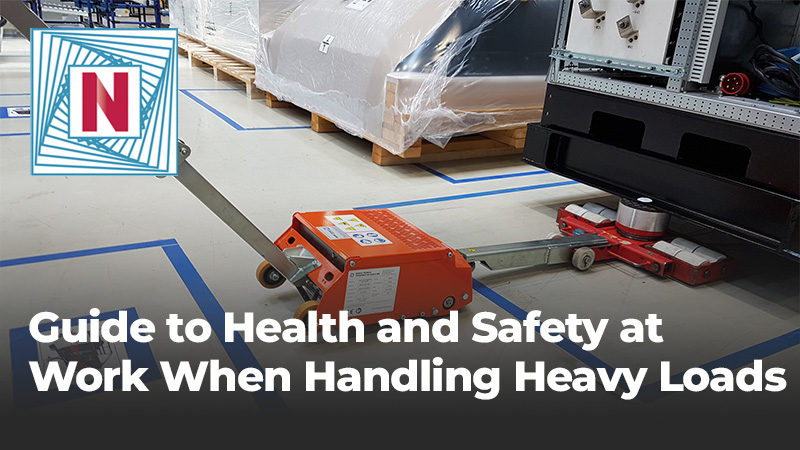
The handling of heavy machinery is one of the most common activities in industrial, logistics and manufacturing settings. It involves operations such as lifting, transporting and towing materials or machinery, which take place under complex operating conditions.
If not managed properly, this activity can create hazardous situations for workers, jeopardising their health and the continuity of production processes. To ensure safe working conditions, it is necessary to carry out a proper risk assessment, adopt appropriate organisational measures and use suitable mechanical means and equipment.
In this context, the main objectives are compliance with regulatory obligations and the establishment of a system that safeguards the physical well-being of the operator, taking into account the characteristics of the environment, the load and the task being carried out.
How to prevent accidents: equipment for safe handling
Unlike the handling of light packages, the manual transport of industrial machinery involves risks that are often incompatible with safe operating conditions.
As explained by our experts in the dedicated webinar, working with this type of plant presents many critical issues: heavy loads, unstable centres of gravity, irregular dimensions and complex manoeuvres to be carried out in confined spaces. In the absence of suitable equipment, such operations can cause:
- Limb crush injuries, particularly during release or repositioning;
- Load drops, due to imbalance or loss of control;
- Muscle strains and lower back injuries, which are common in the absence of mechanical aids;
- Strain injuries, resulting from manually pulling or pushing non-standard loads.
These conditions are often the result of poor organisation or the use of inadequate equipment. Legislative Decree 81/08, concerning health and safety at work, imposes theobligation to avoid manual lifting when the risks exceed acceptable limits.
A safe operation must therefore include:
- Remote-controlled mechanical equipment, which allows the lifting and transport phases to be managed whilst keeping the operator at a safe distance;
- ‘Under-machine’ systems, designed to lift the load a few centimetres and limit its instability;
- Detailed planning of each operation, including an analysis of the context and a precise definition of roles and operational trajectories;
- Technical risk assessment using recognised methods, to be applied according to the type of operation and the characteristics of the environment;
- Bespoke design, based on the actual conditions of the operation and aimed at ensuring safety, operational continuity and compatibility with the site’s structural constraints.
Therefore, to carry out operations effectively, it is essential to use suitable mechanical systems, such as:
- Remote-controlled motorised robots of various power ratings, with the Robot 40 having a maximum load capacity of up to 46 tonnes, ideal for moving industrial machinery remotely in confined spaces and on uneven surfaces;
- Heavy-load transport trolleys, available from two different brands. The GKS-Perfekt trolleys, capable of carrying up to 120 tonnes depending on the chosen configuration. The NTS series, with load capacities ranging from 10 to 60 tonnes, featuring low-profile decks and a reinforced structure.
This equipment ensures stability, control and precision, enabling operation in complex environments, whilst complying with health and safety standards at work.
Safety in load handling and employers’ obligations
As mentioned in the previous paragraph, the manual handling of loads is one of the activities which, according to the law, can give rise to significant hazards for workers.
Legislative Decree 81/08, specifically Article 168 and Annex XXXIII, stipulates that the employer must adopt organisational and preventative measures to ensure adequate safety conditions during such operations. The main regulatory obligations are:
- To assess the risks associated with the lifting, carrying, pushing, towing or supporting of loads by hand.
- To avoid manual handling where conditions permit automation or mechanisation.
- To adopt the necessary organisational measures to limit workers’ exposure to potentially harmful situations.
- To provide appropriate means and equipment where manual handling cannot be avoided.
- To take individual factors into account, such as the gender, age and physical condition of workers.
- Train staff on the specific risks associated with manual handling and on the correct techniques to adopt.
- Update the risk assessment periodically, including in relation to changes in loads, the working environment or operational organisation.
When operating conditions are complex, relying on companies specialising in industrial handling is always the best choice to ensure regulatory compliance and the protection of health.
Let us look at how to carry out risk assessment using recognised methodologies.
Methods for assessing manual handling risk
To ensure an objective and documented analysis of the risk associated with MMC (Manual Handling of Loads), the employer must adopt methods recognised at a technical and scientific level.
There are three main methods – NIOSH, Snook-Ciriello and OCRA –which are internationally recognised and used for the technical assessment of manual handling risks. They are also adopted as a reference in the UNI ISO 11228 standards and the INAIL guidelines.
Specifically:
- The NIOSH method (National Institute for Occupational Safety and Health) assesses the risk associated with lifting loads in relation to factors such as grip distance, frequency, posture and load weight. It produces an index indicating whether the activity is acceptable or critical.
- The Snook-Ciriello method is used to assess pushing, pulling and carrying operations. It takes into account the average biomechanical capabilities of the working population and compares them with the characteristics of the task.
- The OCRA method (Occupational Repetitive Actions) is suitable for repetitive upper-limb tasks. It analyses movement frequency, recovery times, posture and force applied.
There are also simplified checklists (INAIL forms), used for an initial assessment in less complex contexts, which provide a preliminary risk assessment and guide the choice of the most appropriate method.
Generally speaking, the adoption of the correct method always depends on the type of task, the frequency of movements and the characteristics of the working environment.
Bespoke designs for safe working
Standardised solutions are often unsuitable for these contexts. A bespoke design ensures the health and safety of the operators involved. It mitigates the risks associated with manual handling through the use of efficient and safe machinery.
It is necessary to:
- Study the actual handling flows, analysing structural constraints, access points, ramps, gradients and loading/unloading procedures;
- Select equipment compatible with the required load capacity, as well as with operating conditions such as operating range, guidance system and precision during release;
- Define specific operating procedures, tailored to the operators’ skills and the safety standards of the specific environment.
At Nuova Tecnica, we support every client from the preliminary analysis right through to the selection and supply of systems designed for handling heavy loads. We offer certified machinery which, when used correctly, guarantees the safety of handling operations.