
How to move heavy industrial cabinets without dismantling them in professional settings
Blog > How to move heavy industrial cabinets without dismantling them in professional settings
A heavy cabinet is one of the most difficult pieces of furniture to move without dismantling it: it is tall and narrow, its weight varies depending on its contents, and it offers few secure grip points. All it takes is one unbalanced movement for it to tip over, bump into a wall or scratch the floor.
In professional settings such as offices, archives and businesses, moving a cabinet involves additional constraints. The furniture is often made of metal and filled with files; the premises remain operational whilst the work is being carried out; and those responsible for moving the furniture – from in-house maintenance teams to office removal firms – must minimise the time taken, the effort required and the risks to staff.
Nuova Tecnica, an ISO 9001-certified company, has specialised for years in the lifting and handling of heavy loads and supplies equipment specifically designed for the workplace.
- Why moving cupboards in offices, archives and businesses is different from a domestic move
- Who is responsible for relocations in professional settings
- The weight and contents of metal and filing cabinets
- Building obstacles: passageways, lifts and floors
- Timeframes for operations in working environments
- The risks of manually moving heavy cabinets
- How to move a heavy industrial cabinet without dismantling it: the steps involved
- PAL-BAC multi-grip pallet truck: the solution for heavy cupboards and furniture
- When to use a multi-grip pallet truck: metal cabinets, filing cabinets, office furniture and other loads
- Frequently asked questions about moving heavy industrial cabinet
Why moving cupboards in offices, archives and businesses is different from a domestic move
In a domestic move, the cupboard is emptied, dismantled into panels and moved by several people, usually over a dedicated day. In a public office, a professional practice or a company warehouse, this approach is rarely feasible: there is a large quantity of furniture to move, the contents must be kept in order and the operation must be carried out at times that suit those working on the premises.
Who is responsible for relocations in professional settings
The task of moving cabinets falls to different roles depending on the context. In local authorities and public bodies, this is usually handled by the in-house maintenance team or the technical department, which also manages storage archives. In schools, work is concentrated during school holidays, whilst in hospitals it must be co-ordinated with the wards and the movement of patients and staff.
In private offices and professional practices, the task often falls to office removal firms, which handle large quantities of furniture within tight timeframes; in companies, facility management comes into play, as it must coordinate the operation with production. In all cases, whoever organises the operation must also take into account the safety of those carrying it out.
The weight and contents of metal and filing cabinets
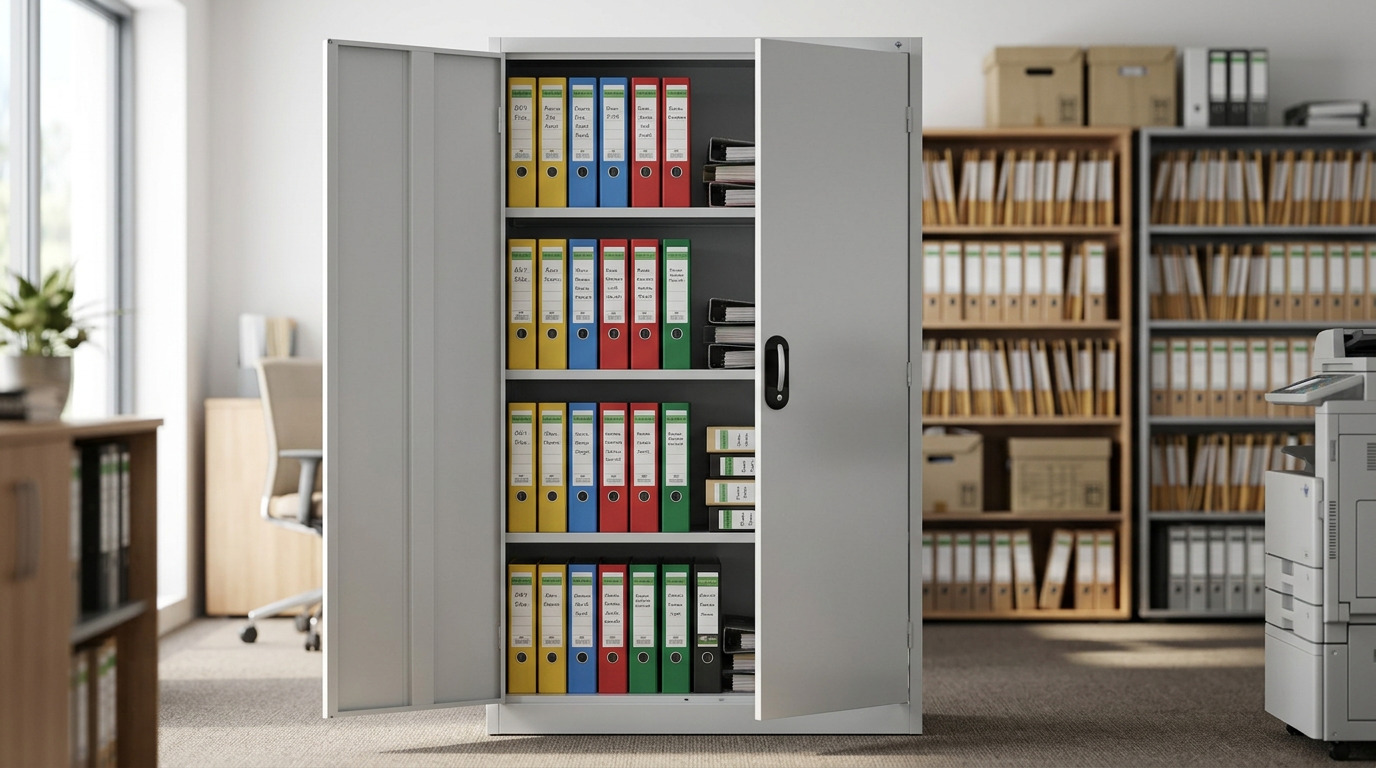
A filing cabinet full of folders or a metal cabinet with full shelves concentrates a heavy load in a small space, distributed unevenly across shelves, drawers and doors. Emptying it is not always a solution: it means moving dozens of folders, keeping them in order and rearranging them in their new location, with the risk of losing documents or disrupting access to the archive.
Building obstacles: passageways, lifts and floors
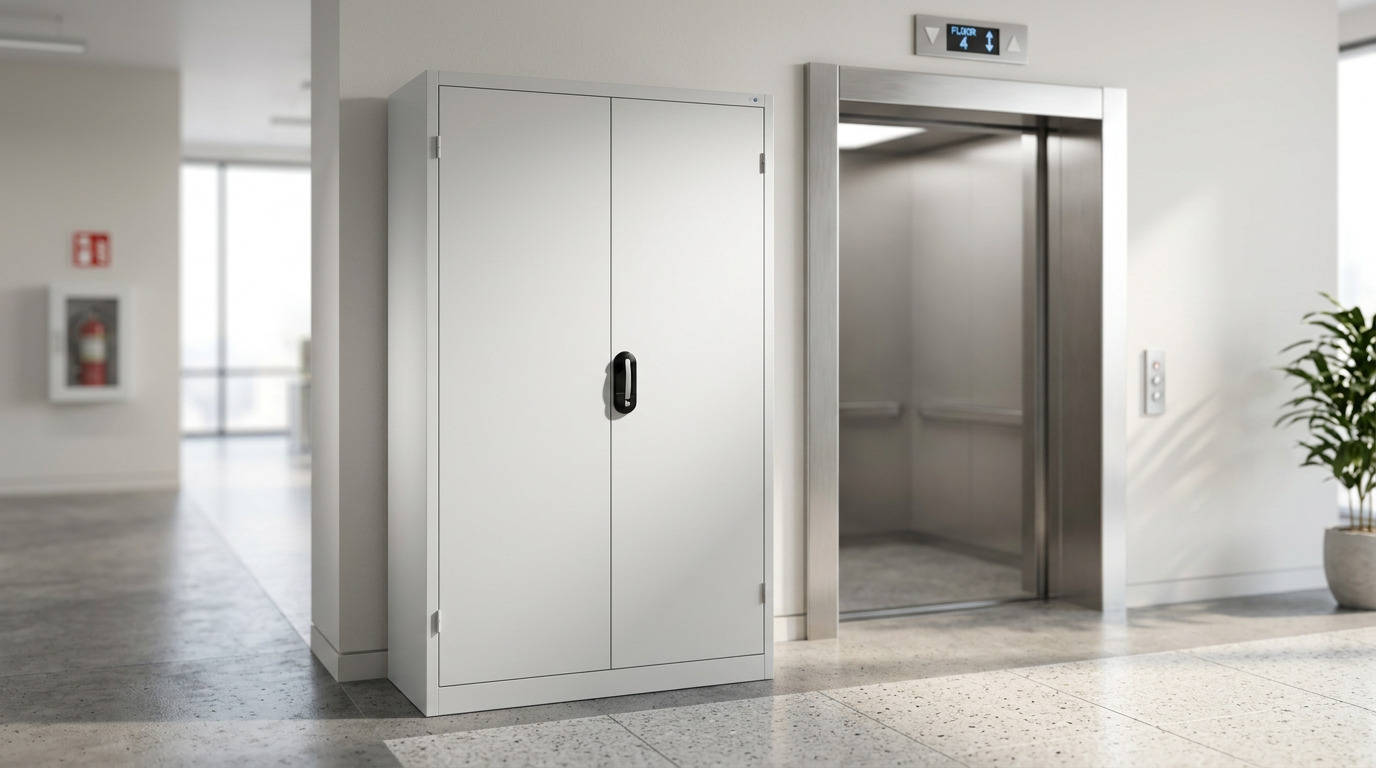
Narrow corridors, fixed-width openings, thresholds and fire doors hinder the movement of bulky furniture. There may be no lift, or the existing one may have insufficient capacity or dimensions, and not all buildings have a goods lift. Furthermore, delicate flooring is common in offices: parquet in law firms, carpet, resin flooring or raised floors covering services may not withstand being dragged across or concentrated loads at a single point.
Timeframes for operations in working environments
Local authority archives, schools, hospital wards and offices open to the public do not shut down for a move; for this very reason, thework must be carried out within tight time slots, often outside normal working hours, in areas where people are moving about and where a blocked passageway causes disruption. For those carrying out the move – whether it be the in-house maintenance team or an office removals company – the aim is to move the cabinet without dismantling it, in the shortest possible time and without causing any damage.
The risks of manually moving heavy cabinets
Moving a heavy cabinet by hand – by pushing, tilting or lifting it with one’s arms – exposes people to risks affecting both the individuals involved and everything in the vicinity of the cabinet:
- Operators: excessive strain on the back and shoulders, hands and feet being crushed, and the risk of the cabinet tipping over when it is tilted or loses its footing;
- Furniture and documents: metal frames that may become distorted if lifted from a single corner; doors and drawers that open during movement; files that fall or become jumbled;
- Building: impacts against walls, door frames and doors; scratches on floors; raised floor panels damaged by a concentrated load;
- Activities: delays, staff being taken away from other tasks and blocked passageways; furthermore, an accident can bring a department to a standstill for far longer than the time taken to move the load.
The manual handling of loads is regulated by Title VI of Legislative Decree 81/08 and includes the actions of pushing, pulling and moving a load. Article 168 requires the employer to organise work and to use mechanical equipment to avoid manual handling; where this cannot be avoided, the risk must be reduced through organisational measures and appropriate equipment.
Obligations and assessment methods for preventing accidents are set out in detail in the guide to safety in the handling of loads.
How to move a heavy industrial cabinet without dismantling it: the steps involved
Moving a heavy cabinet without dismantling it is a task that depends above all on preparation: each step reduces one of the risks associated with the load, the route or the people involved. The main steps are:
- Assess the weight: the actual weight depends on the contents rather than the cabinet itself, and a full filing cabinet weighs much more than the same structure when empty. It is best to estimate this based on its dimensions, material and how full it is, and decide whether to lighten the load, at least on the top shelves.
- Check the centre of gravity and the structure: a tall cabinet with the load concentrated at the top tends to lose balance as soon as it is tilted. Before lifting it, check the plinth, feet, joints and any wall fixings that need removing, identifying any weak points that should not be used as leverage.
- Secure doors and drawers: doors locked or secured with a strap, and drawers secured, prevent them from opening unexpectedly during transport and stop files from falling out.
- Clear the route: the route must be measured in advance, taking into account the width of corridors and doorways, thresholds, bends, and the load capacity and dimensions of any lift or goods lift. Obstacles along the route must be removed and, if people are moving about in the premises, the passageway must be cordoned off.
- Protect floors and walls: tarpaulins or rigid panels on delicate floors and protective coverings on the edges of door frames and walls minimise scratches and knocks in the narrowest passageways.
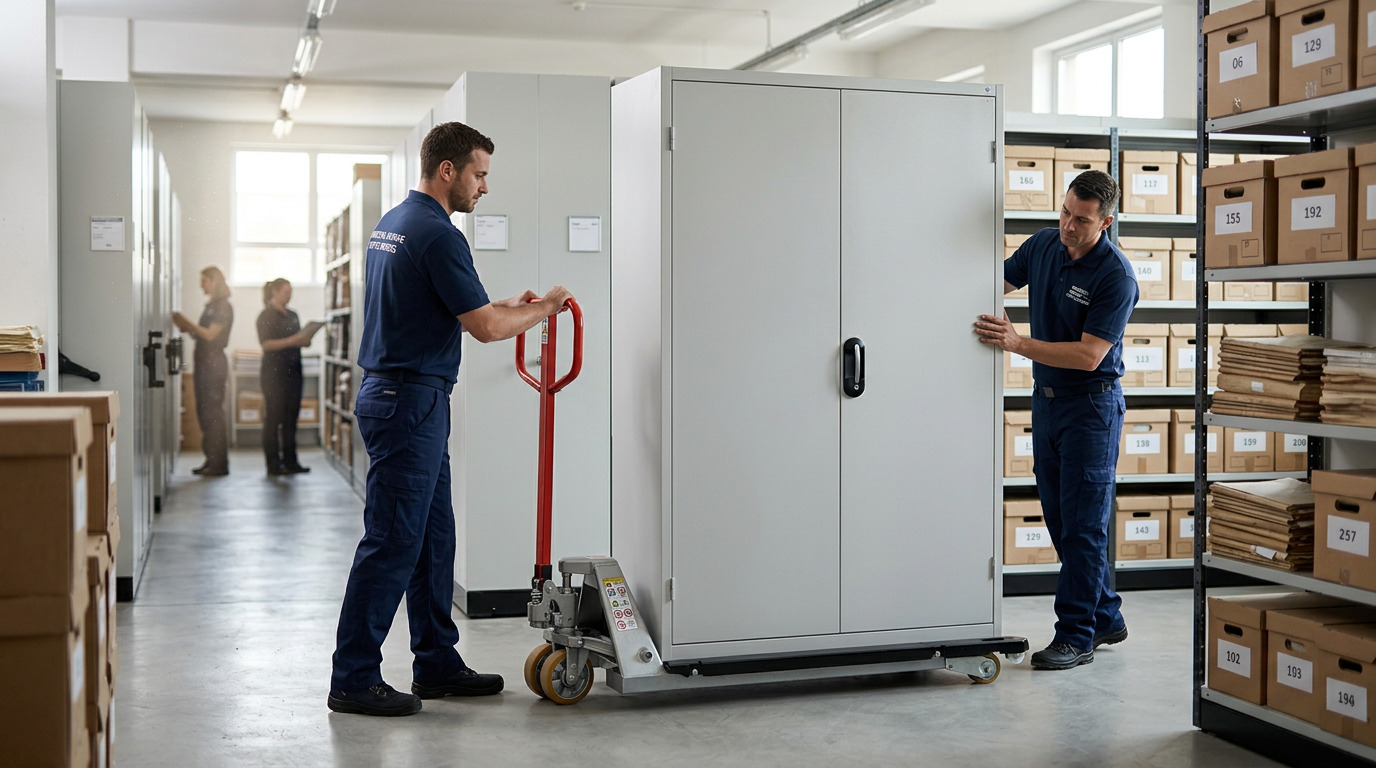
- Use dedicated handling systems: equipment that lifts the furniture a few centimetres off the floor and transports it on wheels prevents dragging, tilting and manual lifting. The number of operators depends on the weight, route and equipment; two people are often sufficient – one to manoeuvre the equipment and one to monitor stability and watch out for obstacles.
- Lifting, transporting and repositioning: the load is lifted just enough to clear the floor, its stability is checked, and it is then moved at a constant speed, slowing down on bends and over thresholds. In its new position, the wardrobe must be lowered gradually and, if required, secured to the wall once more.
Of all the steps involved, the choice of equipment is the factor that has the greatest impact on the time taken and the safety of the operation. With a system that lifts the cupboard and transports it on wheels, the unit remains intact and closed, and the operatives do not have to bear its weight. If the route has been prepared in advance, the load reaches its destination more quickly and without damaging floors or walls.
PAL-BAC multi-grip pallet truck: the solution for heavy cupboards and furniture
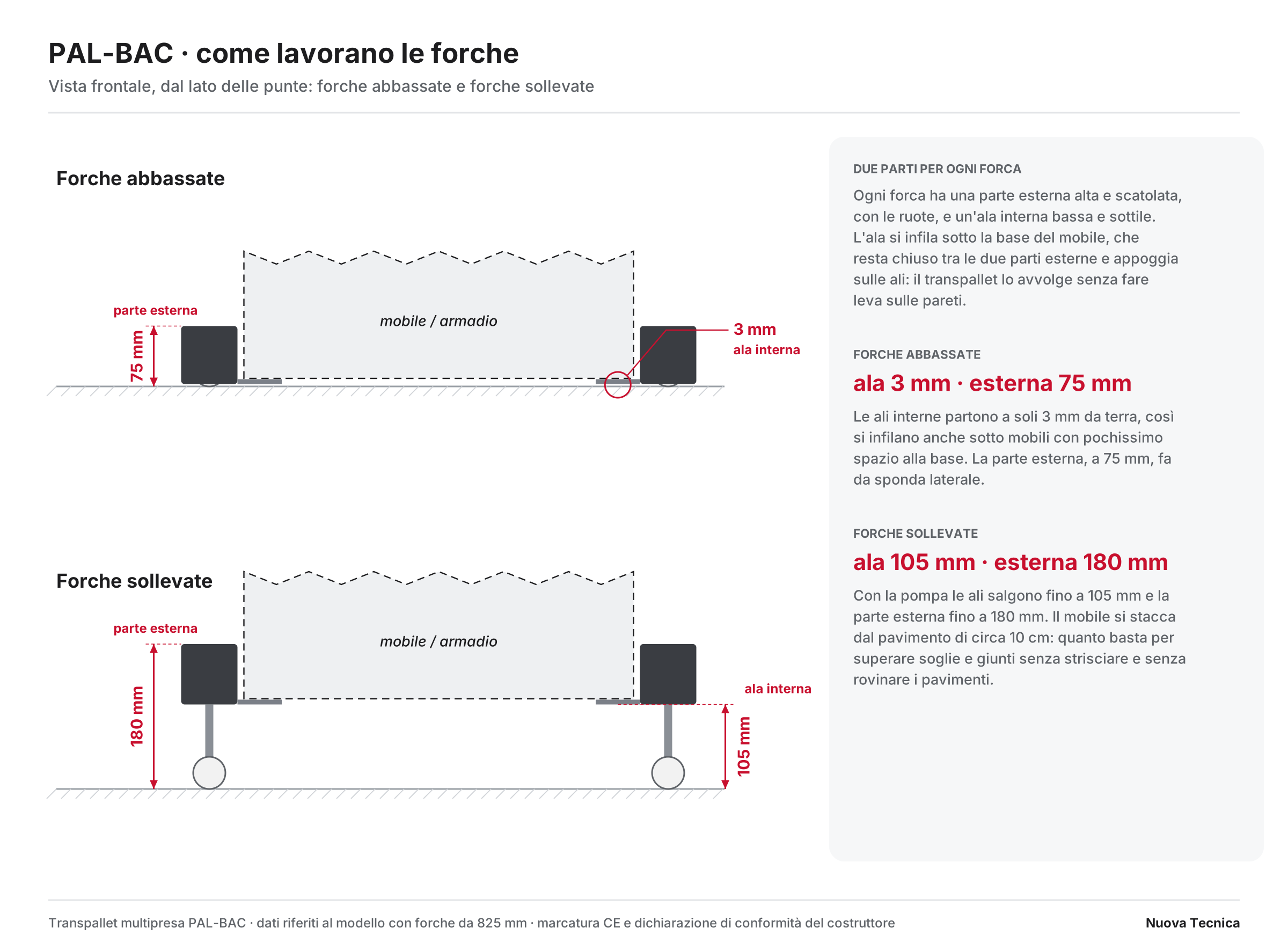
The PAL-BAC multi-grip pallet truck is designed to move heavy and fragile furniture. The forks can be adjusted to adapt to the width of the load and wrap around it, so that the cupboard is transported without marking its structure or surfaces.
Compared to manual methods of moving heavy furniture, the PAL-BAC transfers the weight from the operators’ arms to the forks and keeps the furniture off the ground, without dragging it across delicate floors.
It is a piece of equipment built for those who move cupboards as part of their job: the removal firm relocating an office outside normal working hours, the maintenance team at a public body reorganising an archive, or the company clearing a department to make way for new workstations.
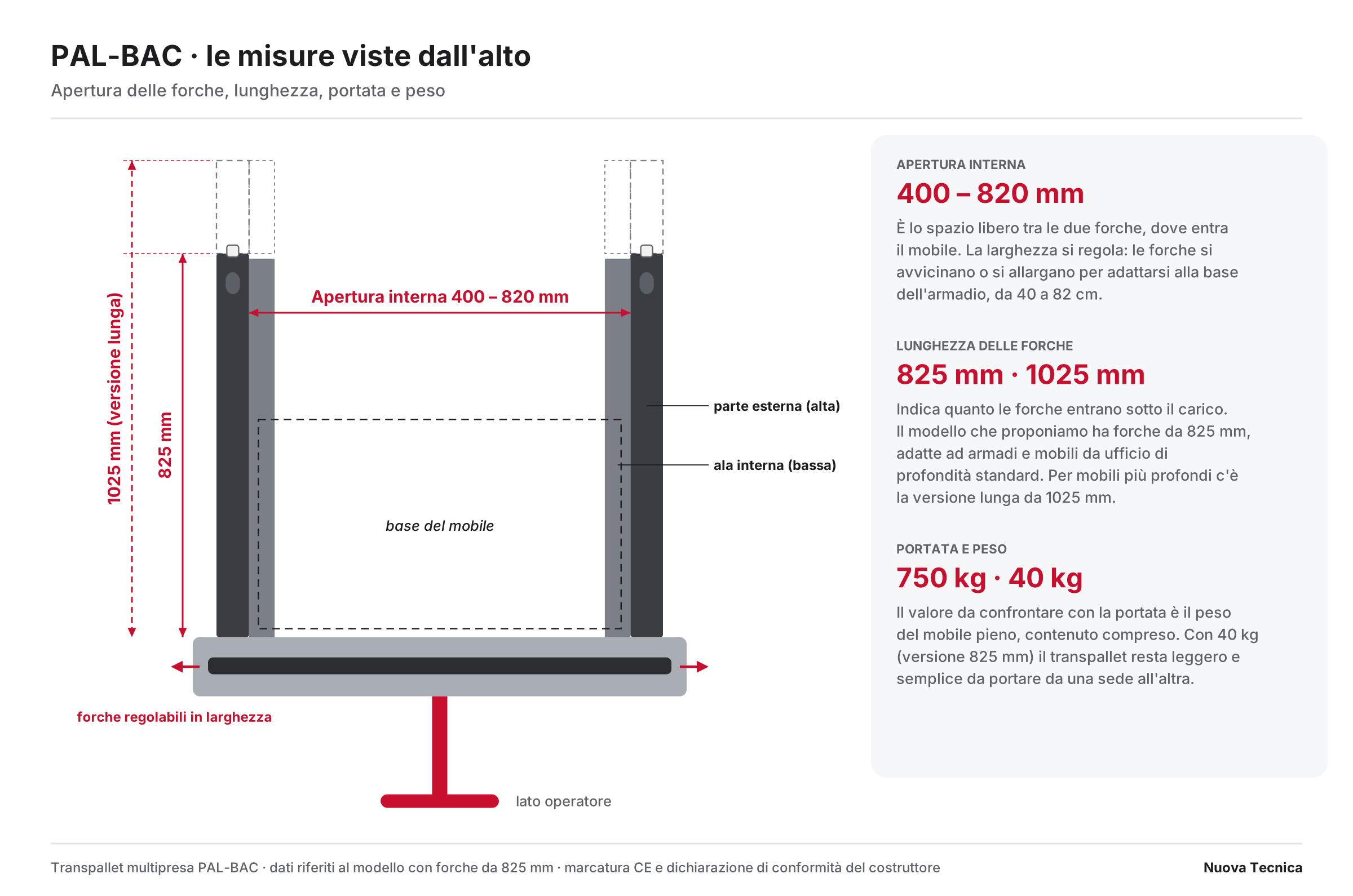
It is the technical specifications that make it possible to move the cupboard without dismantling it:
- Load capacity of 750 kg: this is the figure to compare with the estimated weight of the cabinet, including its contents;
- Fork opening from 400 to 800 mm: this allows the grip to be adapted to cabinets and office furniture of different widths;
- Fork length of 825 or 1025 mm, depending on the model: this should be chosen based on the depth of the furniture;
- Fork height from the ground: minimum 3 to 105 mm, maximum 75 to 180 mm;
- Pallet truck weight of 40 or 44 kg, depending on the model: a useful figure if the equipment needs to be carried between different floors or sites.
When to use a multi-grip pallet truck: metal cabinets, filing cabinets, office furniture and other loads
A multi-grip pallet truck is the right choice when you need to move a heavy piece of furniture that cannot be safely handled by hand, must arrive at its destination undamaged, and the route is on level ground, passing through corridors, doorways and lifts.
In these circumstances, the most common loads in the workplace are:
- Metal cupboards: changing room cupboards, tool cupboards and security cupboards, which have rigid frames but sheet metal sides that can become dented if not gripped correctly;
- Filing cupboards: cupboards with doors or drawers full of files, where the priority is to move them without disorganising the contents;
- Office furniture: bookcases, drawer units and furniture made of wood or laminate, with finishes and edges that can be damaged by dragging;
- Other loads: pallets, skips, industrial containers and fruit and vegetable crates, which can be lifted using the adjustable forks without the need for additional tools.
Where furniture is of non-standard dimensions or weight, or the route presents particular constraints, it is advisable to assess the equipment through a technical consultation prior to the operation. A preliminary assessment helps to manage the move without unforeseen issues, to prevent injury to people and damage to premises, and to handle the furniture without causing strain to the operators.